Hear about Fujiwara Hidesato on Episode 6 of our Podcast, the Japan Archives. |  | 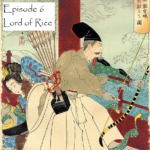 |
Fujiwara Hidesato (藤原 秀郷), also known as Tawara Tōda (俵藤太),3 appears in the folktale My Lord Bag of Rice. He is said to have had the nature of a warrior, with a huge bow much taller than himself.1
Table of Contents
Family
Hidesato was a descendant of Fujiwara no Uona and the son of Fujiwara no Murao, and so part of the Fujiwara Clan.3
Historical background
He is known to have been a military official serving under Emperor Suzaku.2
Exiled in 916 CE, he was later pardoned and appointed ōryōshi (military constable) in Shimotsuke.3
In 940 CE he formed an alliance with Taira no Sadamori to defeat Taira no Masakado. Afterwards he was made Chinjufu-shōgun and Governor of Shimotsuke. Hidesato had many descendant clans, among them the Ōshū Fujiwara, Shimokōbe, Oyama and Yūki clans.23
My Lord Bag of Rice
In the story, Hidesato, wanting adventure, set out across the Seta-no-Karashi Bridge on Lake Biwa, where he found a dragon lying across it. Undeterred, he walked over it, and at once the dragon took human form and revealed himself as the Dragon King.
The Dragon King begged Tawara to help him kill the giant centipede Seta, who lived on Mount Mikami and was taking members of his family. He agreed.
They waited in the Dragon King’s Palace at the bottom of the lake until the centipede appeared. He then went to face the centipede and shot two arrows at its forehead. Both hit the creature in the centre of its head but glanced off, as its shell protected it.
After a few moments he remembered that human saliva is deadly to centipedes, so he wet his last arrow with his saliva and shot again. This time the arrow pierced the creature and killed it. In thanks, the King held a banquet for him in his palace and gave him:
- A large bronze bell.
- A bag of rice.
- A roll of silk.
- A cooking pot.
- A bell.
In the end he gave the bell to Mii-dera. The bag of rice never emptied, the roll of silk never grew shorter, and the cooking pot cooked delicious food whatever was put in it. Because of this he became very wealthy.1
Yōkai connections
Some sources claim that Hidesato fought a creature known as the Dōmeki.4
See also
Footnotes
1. Ozaki, Y.T. (1903) “The Japanese Fairy Book”. Westminster: Archibald Constable & Co. Ltd.
2. Frédéric, L. (trans. K. Roth) 2002. Japan Encyclopedia. Belknap Press of Harvard University Press.
3. Kodansha. (1993) ”Japan: An Illustrated Encyclopedia”. Tokyo: Kodansha Ltd.
4. Yoda, H. & Alt, M. 2016. Japandemonium Illustrated: The Yokai Encyclopedias of Toriyama Sekien. Dover Publications.

Read next
 PeopleFujiwara no HidehiraFujiwara no Hidehira of the Ōshū Fujiwara, lord of Mutsu and Chinjufu-shōgun, sheltered Minamoto no Yoshitsune; his mummy lies at Chūson-ji.
 PeopleFujiwara no TakaieFujiwara no Takaie, son of Michitaka, was Governor at Dazaifu in Kyūshū and fought the pirates who raided Iki and Tsushima.
 PeopleFujiwara no SanekataFujiwara no Sanekata, great-grandson of Tadahira, was sent to Mutsu Province and is said to have become the Nyūnai-Suzume; his poem is No. 51 of the Hyakunin Isshu.