Category: Podcast

All Pages on our site linked to the Podcast.

Be sure to subscribe to our Podcast: Japan Archives. A weekly podcast into bite sized pieces of Japanese History.

If you want to help out our website let us known through our Contact Us page. We are a small team and any help from people who love Japanese history would only help to make this website expand even quicker than we are doing now.

Thank you for visiting our website, we try our best to make a useful website for all history enthusiasts and we hope you will recommend our site to others and come back again and again to learn more of Japanese History.

  • EP17A Human Sacrifice

    EP17A Human Sacrifice

    Show Notes for episode 17A of our Podcast – Human Sacrifice.  

    Story Notes

    Human Sacrifice
    EP17A Sacrifice: Human

    Archaeologically speaking, the act of human sacrifice has never been documented in Japan. So I want to look into the old tales told of this practise.

    The Bow

    In times long past there was the belief that the bow possessed supernatural powers. And at times it was said one would suddenly appear on the roof of peoples homes showing them that a sacrifice had to be made. This sacrifice being the eldest unmarried daughter of the household. Now over time the bow has become a symbol of security instead. However, during these times the girl would then be taken from her home and buried alive so that the ‘God of the Wild Beast’ could consume her. Now the reason behind this was so that the family would be blessed with good hunting.

    High and Low Rank

    Another practise was that, should someone of note or higher ranking die then a number of people would be buried up to their heads in a circle around the deceased. As their heads were still exposed it allowed them to mourn and wail for the deceased until they were eventually attacked by wild animals and their faces eaten. The records say that such practises were eventually ended during the reign of Emperor Suinin.

    The story surrounding the end of this practise goes as follows. On the 25th day of the 6th month in 781 a petition was addressed to the reigning Emperor Kammu by a member of the Haji Family.

    This family, known as the Haji Clan in Japanese (who oversaw the Haji Be) came asking permission to change their family name to Sugawara. The place in which the family now dwelt. But anyway, that has nothing really to do with Human Sacrifice, so let’s move on to what the petition had to say.

    According to the petition brought by Haji no Sukune Furuhito in days long past the practise of human sacrifice was still undertaken, with the high ranking nobles retainers buried alive alongside them as we have already states. The event he cites is the death of Empress Hibasuhime, upon her death it was asked what should be done; many cited to continue the practises of old and to bury people alive with her. However, a man known as Nomi no Sukune is said to have spoken up. Nomi was an ancestor of the Haji Be and stated the following.

    ‘It is my humble opinion that the practise of burying retainers alive is absolutely contrary to the principals of the benevolent government and is not the way of developing the nation and benefiting the people.’

    And so Nomi took 300 potters with him, and crafted clay into many different images of people and things which he then presented to the Emperor Suinin. The Emperor upon seeing these creations was pleased and used them to replace the burying of living people. The Emperor dubbed these figurines Haniwa.

    The Gods of Mimisawa

    Now this story comes from the Uji shui monogatari.

    The Gods of Mimisawa are a snake and a monkey. These Gods go by the names Koya and Chusan. Every year they would receive a sacrifice in the form of a pretty girl with long hair and fine white skin.

    A girl was chosen, and she spent her days in mourning for her future death until one day a hunter appeared. He was large and strong, and learning of her sad fate wished to know what she could have possibly done in a previous life to have earnt such a horrible end to this one.

    He said that it would be best for him to kill her, to give her a quick and easy death instead of suffering at the hands of the gods and her parents agreed.

    But, when he laid eyes upon her, his beauty made him change his mind. And so a new plan formed in his mind.

    He told the parents of the girl to stretch a sacred rope around their home, and to say it is to purify their daughter for the upcoming sacrifice and to allow no one to enter.

    The hunter spent days sharpening his blades, spending time with his dogs who he had trained to kill monkeys, and wiling away the hours with the girl who he now loved. The girl he would sacrifice himself for. They talked every day, the girl grateful that she would now live.

    The day of the sacrifice finally came, the priest appearing at the home with a box for the girl to climb into.

    The hunter takes her place instead, carefully climbing inside with his dogs and the weapons he had been sharpening day after day.

    The priests take the box, unaware of the man inside. They reach the shrine, open the sanctuary doors and leave after placing the box inside as offering.

    The hunter carved a spyhole in the box to see the Gods who would take his life.

    There was a giant monkey, 8ft tall with a red face and long glossy white fur. The God was surrounded by 200 monkeys, a carving board and knife laid out before them.

    The giant monkey, the god, approached the box and undid the lid.

    As soon as it was free the hunter cried for his dogs to attack. They grabbed the god, the hunter leaping from the box to forced the god onto the cutting board; a sword against the monkeys throat.

    He screamed at the god “what do you get for killing and eating people. Listen to me! I’m going to cut of your head and feed it to my dogs! All these years you’ve been eating women and leaving people childless! Now your head comes off!

    All the while the dogs had chased all the monkeys into the nearby trees, who now were screaming so frantically the mountains rang with the sound.

    The god possessed one of the nearby priests and begged for his life. “The practise must stop!” He said, “I have learned not to kill humans. Priests, don’t harm the man who came to punish me. Leave the family who was supposed to make an offering alone. From now on I shall protect them and their descendants! Priests, beg this man for my life! I am in danger!”
    The Priests came and made promises that their god had learnt his lesson, and the hunter relented, taking the sword from the gods throat.

    And from then on, the practise stopped and only boar and deer were served as offerings.

    The hunter, the girl who he later married, and her parents all were safe from that day onwards.

    Poem Notes

    We don’t know much about Moriya Sen’an. We know he was a poet who wrote Death Poems, and the man himself died in 1838. He wrote a humerous death poem which uses his own name within its lines as a humours notes.

    我死なば
    酒屋の瓶の下にいけよ
    もしや雫の
    もりやせんなん

    Ware shinaba
    sakaya no kame no
    shita ni ikeyo
    moshi ya shizuku no
    mori ya sen nan

    Bury me when I die
    beneath a wine barrel
    in a tavern.
    with luck
    the cask will leak.

    Feature Image: Buried Alive: AlphaCoders

    You can listen to the full podcast episodes here: Japan Archives, or wherever you listen to Podcasts.

    Follow us on Social Media: Instagram: @japan_archives

    We also started a Youtube channel for Japan Archives.

    And another for other creative endeavours!

    Heavenly Spear

  • EP16 The Devil’s Gate

    EP16 The Devil’s Gate

    Show Notes for episode 16 of our Podcast – The Devil’s Gate.  

    Story Notes

    The Devil's Gate
    Zodiac Compass. Website: HERE.

    We have portrayals of the Yokai known as the Oni, which Heather mentioned in the previous episode about Momotaro. You can find his depiction in his Yokai compendium called the Konjaku Gazu Zoku Hyakki. He depictions are interesting as he would often include a small titbit of information alongside the pictures. Sekien states for the Oni that they are names after the direction of the north-east, which is called the Kimon. Kimon translating to the Devil’s Gate or the Gate of the Oni.

    So what exactly is the Devil’s Gate.

    Now the devils gate as we have said is the name for the direction of the North-East, based on the Chinese Zodiac. You can even buy compasses that instead of showing the cardinal directions they instead have the kanji for the zodiac creatures on them so you known in which direction you can find the Kimon.

    Now this directions is known for its extreme bad luck, for it is the direction in which demons, evil spirits and supernatural creatures pass through. Now there are certain ways to block this ill luck, and to stop these creatures from gaining entrance.

    Now take a look at these two pictures (taken from the official websites), one is a plan of the Kyoto Imperial Palace and the other of the Tokyo Imperial Palace. You’ll see that there in the walls of the Kyoto Palace and the moat of the Tokyo Palace that in the north-east side there’s a notch, and this would be effective in halting the ill luck from gaining entrance into the Palaces of the Imperial Family.

    The Devil's Gate
    Layout of Kyoto Imperial Palace
    The Devil's Gate
    Layout of Tokyo Imperial Palace

    On Mt. Hiei , the temple for Enryaku-ji, which we mentioned all the way back in Episode 2 was built was constructed in helping to block these evil spirits. This temple built to the north-east of Kyoto, and temples were a way of halting and deterring these creatures and bad look because of them being holy places. Of course some would say this is not the reason behing Enryaku-ji as it was built 6 years before Kyoto even existed; but its a nice theory none the less. Similarly, mentioning again the Imperial Palace in Tokyo. When it was first constructed by Tokugawa Ieyasu it was known as Edo Castle, and the Kanei-ji Temple in Ueno Park was contracted to protect it from the kimon because Ueno hill is located in the devil gates direction. Senso-ji is also purported to act as a barrier in Tokyo to malignant spirits.

    Houses with an entrance which faces this direction are thought to be extremely unlucky and so it is best not to live in them and it is said that when buying a house you must take into consideration where the kimon within the house is, if there is a window or a door there then it is best to find somewhere else to live. Rooms such as the kitchen or the bathroom are seldom constructed in the north-east corner of a Japanese home. It is even said that when building a house water pipes for example will be laid in a way to avoid the north-easterly section of a home.

    Alternatively, if you have to move into a house with the bad luck of the kimon, one should first retire to a house full with good luck and stay there for a short while before taking this good luck to the house of ill luck to in a way exorcise it.

    And finally, if you live in a part of Japan where you’re lucky enough to have a garden, it is said that you must not place a stone that is more then 1.5 metres in height in the north-east as it will allow devils to enter your property.

    Poem Notes

    The Devil's Gate
    Sarumaru Taifu

    Sarumaru Taifu, also called Sarumaru Dayu (猿丸大夫) lived during the mid 8th century, or so we believe. This poet may in fact have never existed in the first place as there are no records to prove he ever lived.

    He was listed by Kinto as one of the Thirty-Six Poetic Geniuses and there is a later collection of poetry known as the Sarumaru Dayū, but due to the fact this man may not have existed it is highly unlikely this poetry collection was penned by him.

    His poem from todays episode goes as follows:

    奥山に
    紅葉踏みわけ
    鳴く鹿の
    声きく時ぞ
    秋はかなしき

    Okuyama ni
    momoji mireba
    naku shika no
    koe kiku toki zo
    aki wa kanashiki

    In the deep mountains
    making a path
    through the fallen leaves,
    the plaintive belling of the stag-
    how forlorn the autumn feels.

    Feature Image: Demon Gate by William Niu (Source: Blogspot.com)

    You can listen to the full podcast episodes here: Japan Archives, or wherever you listen to Podcasts.

    Follow us on Social Media: Instagram: @japan_archives

    We also started a Youtube channel for Japan Archives.

    And another for other creative endeavours!

    Heavenly Spear
  • EP15 Son of a Peach

    EP15 Son of a Peach

    Show Notes for 15 of our Podcast – Son of a Peach. Also known as the Peach Boy.  

    Story Notes

    Son of a Peach
    Momotaro coming out of the peach.

    Mukashi, mukashi, there lived an old couple. This couple was very happy, but they never had a child. They spent their days on their farm doing chores. 

    Now, the old woman liked to wash her clothes at the same place by the river. She was very proud of how clean her laundry was and she worked very hard to make it “pika pika”, or sparkling clean. Well, on this particular day, she was getting ready to take her laundry home when, bobbing along the river, there was a huge and delicious looking peach! 

    “Oh! I must get that peach! It will be a wonderful treat for my husband and I to share!”

    She grabbed the peach from the water, put it in her basket with all her clothes, and headed home.

    Her husband was tending the fields close to home, so when she arrived “Anata! Come! Let’s share this peach I found by the river!”

    ‘Eh” he said. (He was a little hard of hearing) But he came all the same.

    The old woman grabs her knife, but before she can cut the peach it splits in two and out pops a baby boy!

    The couple, shocked but very happy, decide to name him Momotaro, since he was born from the “momo” or Peach.  

    Momotaro grew big and strong and brave! He always helped his family and those who were in need around his home.

    One day Momotaro happened to hear about the Oni (or ogres) from Onigashima Island harassing and stealing from a neighboring village.

    “Mother, father, I must go. I must go and help drive away the oni.”

    “It’s too dangerous!” His parents said.

    “I know, but I must go.”

    His mother, seeing that her son was determined to go, decided she would make him some food for his journey. She poured all her love and hopes and wished for Momotaro to complete his quest into the kibidango that she made. 

    “Here, take these kibidango! I hope they will give you power and strength!”

    “Ganbarimasu!” His father said. Good luck!

    Momotaro heaved his bag filled with kibidango on his back and set out on his journey. 

    He hadn’t gone too far when he saw a dog.  

    “Greetings! Where are you going? And what’s in your bag? It smells sooo delicious.” He sniffed the air and panted.

    “I’m going to Onigashima to defeat the Oni! I’ll give you a kibidango if you wish to come with me!”

    “Yes I will!” Momotaro gave his new friend a kibidango and the two friends set out.

    A short time later they heard a noise in the trees and down swung a monkey!

    “Hello hello! Where are you two going and, huh, what’s that in your bag?”

    “We are going to Onigishima! We are gonna defeat the Oni!”

    “It’s kibidango! If you come with us, I’ll give you one!”

    “Yes I will! Kibidango, if you please!”

    Momotaro gave his new friend a kibidango and the three friends set out.

    They were getting close to Onigashima Island when they heard a ruffle in the nearby grass. Out popped a kiji (a kind of pheasant).

    “Ooo ooo What’s that you have in your bag! And, where are you off to?”

    “We are going to Onigashima!”

    “To defeat the Oni!”

    “It’s Kibidango! If you come with us, I’ll give you one!”

    “Yes, I will!”

    Momotaro gave  his new friend a kibidango and the four friends set out.

    At last, they reached the shore across from Onigashima! They boarded a boat. One the way, they ate their kibidango.

    When they reached the misty shore, they spied an oni!

    “Oi, what are you doing here?” He cried

    “We have come to stop you from terrorizing the village!”

    “Ha, you weak boy, dog, monkey, and kiji?? Do you know how many of us there are?” And like magic up popped many, many oni surrounding Momotaro and his friends.

    “Yes we will!” they shouted! And with that they began to fight!

    Well, what the oni didn’t know was that the kibidango had given our four friends the strength of over a thousand people! They easily defeated the oni!

    “Ouch, ouch! WE are sorry! We’ll leave the village alone I swear! Please, just take the things from the village and leave! We won’t bother anyone again!” And with that tears filled the Oni`s eyes.

    Momotaro and his friends, victorious, took all the stolen goods from the ogres and returned them to the village.

    When Momotaro returned home, his new friends came too! They happily lived together with Momotaro and his parents for many years.

    You may also notice I took some liberty and changed a few small details in this story of Momotaro. My story is a combination of a few other sources I have read in the past, plus I took some creative license. The essence of the story is the same!

    Poem Notes

    Son of a Peach
    Fujiwara no Teika

    We know a lot about the man known as Fujiwara no Teika (藤原定家). He was born in 1162, living until 1241. The son of Fujiwara no Shunzei he was a very famous poet for his time.

    We know a lot about his life from his dairy which was called the Meigetsuki. He grew up during the Heian and Kamakura Periods and partook in many poetry competitions as well as acting as a judge. Known examples were competitions known as the Hyakushu, in which a poet would right 100 poems around a specific theme to be then later judged.

    He was close to the Emperor Go-Toba, prior to as well as after his abdication as emperor. Though this friendship would soon find itself on rocky ground.

    Many years prior to this Teika came into mourning after the passing of his mother, and one day (on the anniversary of his mothers death) the now retired Emperor called on Teika to recite poetry for him. Teika asked if he could not, so he may honour the anniversary of his mothers death, however the Emperor made him come to him none the less. Angered by this Teika wrote two poems.

    These poems, though they fit into the poetic theme the Emperor had asked for, were full of hidden meaning to show the Emperor the anger Teika was feeling towards being made to be hear reciting poetry instead of honouring his mother. One could analyse the lyrics from one poem as saying;

    ‘let us compare which one of us has a greater grevance. [The Emperor] is angry because I declined to come to his party; I am angry because he belittles the affection in which I hold my late, dear mother.’

    It is noted Teika was sent from the palace after angering the Emperor and it is fortunate that this was all that happened to him. Such a break of decorum could easily have seen Teika stripped of his lands and titles because of this.

    sayaka ni mo
    mirubeki yama wa
    kasumitsutsu
    waga mi no hoka mo
    haru no yo no tsuki

    michinobu no
    nohara no yanagi
    shitamoenu
    aware nageki no
    keburi kurabe ni

    The mountain that I
    should be able to see clearly
    have misted over-
    this spring night’s moon
    belongs to someone else.

    A willow in the meadow
    by the side of the road
    has secretly bloomed
    vying against the smoke
    of my smoldering lament.

    You can listen to the full podcast episodes here: Japan Archives, or wherever you listen to Podcasts.

    Follow us on Social Media: Instagram: @japan_archives

    We also started a Youtube channel for Japan Archives.

    And another for other creative endeavours!

    Heavenly Spear
  • EP14B Tales of Fuji

    EP14B Tales of Fuji

    Show Notes for EP14B of our Podcast – Hei! Say my Name. Tales of Fuji.

    Tales of Fuji
    Back of the 1000 yen bill.

    Story Notes

    Lake Motosu

    Tales of Fuji

    Now, after researching this lake I have been unable to find any stories linked to it. So if I am missing something, and if you’re listening an no I story I might have missed please let us know. For the time being all I can tell you is the more sparse, concrete facts about the lake.

    This lake forms a group known as the Fuji-san Goko, or the Fuji Five Lakes. Now all of these lakes, including Motosu were formed due to lava obstructions in the past in the valleys of the Misaka Mountains. Out of these five lakes Motosu is the deepest, at a depth of 122m.

    History of the Mountain

    Fuji San is the highest mountain of Japan reaching a height of 3,776m. It has 3 subsidiary volcanoes by the names of Komitake, Ko-Fuji and Shin-Fuji. Shin-Fuji being the most active has actually covered the other two in cinders and lava.

    We have records of its various eruptions and our first record of Fuji erupting dates all the way back to 864AD.  The mountain has widely been seen as sacred in both Shinto and other faiths, such as the Fujiko which combines both Shinto and Buddhist elements.

    In fact it was the Fujiko sect that established the custom of dividing routes to the summit into 10 stations of stages; although I believe now there are only 8 stations. Due to its historical basis of being deemed sacred, women weren’t allowed to climb the mountain until 1872.

    Legends say that the sand which is disturbed during the day by pilgrims ascending the mountain would re-ascend to its former position at night. According to Buddhist tradition, Fuji rose from the earth in 286 BC after an earthquake that also created Lake Biwa.

    Art

    In art Mount Fuji is the best known from Hokusai’s 36 Views of Mount Fuji, Hokusai being in his 70’s when he created them. In actuality there are 46 prints. As an additional 10 were created by Hokusai after the original collection.

    There was also my the same artist something known as the Fugaku Hyakkei, in English the 100 views of Mount Fuji which was published as a sequel book of sorts to the initial 46 prints.  You can actually go see a lot of his prints in Nagano Prefecture. If you ever are in Nagano city you can take a train to the small town of Obuse where Hokusai would spend his time, and there is a museum there housing both the 36 Views and the 100 Views of Fuji in addition to his other works. And having been myself, I would highly recommend going.

    Behind the Name

    These days the mountain is made up of two Kanji, these being the Kanji for abundance and soldiers/samuria.

    However there is much debate as the origins of the name. It is worth mentioning that there is a folktale known as the Tale of the Bamboo Cutter, where Fuji is said to be derived from 不死 fushi which would translate as Immortal .

    There are others that cite it as an ancient name stemming from the Ainu language namely the Kami of Fire by the name of Huchi but some have contested that and cited it as relating back to the time of Yamato. There is even some who state it could relate to old Eastern Japanese and there word for ‘Fire Master,’ 火主. This was originally pronounced pu suzi, and over time became shortened to puzi and it similar to Fuji.

    The Kami of Fuji

    There are some that cite the kami of Fuji as being Kono-hana-saku-ya-hime. Now, she is interesting mythologically as she is stated to have the one to have married Ninigi, He was the grandson of the Sun kami Amaterasu, and he would later be the great-grandfather to the first Emperor Jimmu.

    It is said that upon the summit of Mountain resided her palace and that the kami could be seen floating over the crater in a luminous cloud at every moment attended to by invisible servants who would throw down any pilgrim who attempted to climb the mountain if they were not pure of heart.

    Princess Glory

    One tale from the Shintoshi recounts a tale of Fuji, this document coming form the 14th Century giving tales of various kami. The story is set during the reign of Emperor Yuryaku, the 21st Emperor from the Kofun Period and goes as follows. Now I want to say that this story has a lot of similarities, for those who known it, with the Folktale The Bamboo Cutters Daughter. But to give you some idea, the character of Kaguya has the same name in both tales and her origins and again the same.

    There was once a couple who were sad as they had no child. This couple living at the foot of mount Fuji. Then one day they found themselves happiness, they found a little girl hidden in the bamboo grove behind their home. Seemingly having appeared from nowhere. This girl was special, shining with light and so they called her Princess Glory, or Kaguya-hime in Japanese. She grew up to be the most beautiful woman and news reached a local governor of her beauty. And so he approached her and they courted for some time before finally marrying.

    Many years later, once the old couple had passed and been lain to rest she revealed to her now husband that she was not of this world, all this time he had been married to the Immortal Lady of Mount Fuji. She had come all those years ago to give the old couple happiness, and now they were gone from the land of the living nothing tied her now to this place. And so she had to return to her palace at the mountains summit.

    Now it is interest to note here that, as we have said, Fuji may have been derived from the word for Immortal, and here we have a kami who name includes the world Immortal. The Immortal Lady of Mount Fuji.

    The governor, her husband didn’t wish her to leave, and so she said he could see her if he climbed to the summit. And failing that he could look at her using a box of incense which she left him as a parting gift. And so she returned to the mountain, leaving her husband alone.

    He used the box but could only see an indistinct shadowy form and so he endeavoured to climb the mountain. At the summit he found a lake, with an island in its centre, and upon it the palace of Kaguya-hime. But, the vapour which rose from the lake only gave him the most fleeting glimpses of his wife, and so disappointed and alone, he clutched the box to his heart and jump from the precipice of the mountain to his death.

    The Elixir of Life

    The story goes there was once an Emperor of China, who heard that Mount Fuji came into being in one night. From this he instantly believed that Mount Fuji must contain the Elixir of Life. And so he set sail to Japan with a number of handsome youths and maidens for Japan. They sailed through storms which luckily eventually abated and before them they could see the rising slopes of Fuji. They ascended the mountain, near it summit the Emperor running ahead, wanting to be the first one to take a drink from the Elixir of Life so that he may never grow old. But later, once his companions caught up with him they only found his body lying on its back with a smile upon his face. He had found his Life Eternal, but would carry it out in the land of the dead.

    Poem Notes

    Tales of Fuji
    Akahito by Utagawa Kuniyoshi

    Yamabe no Akahito (山部 赤人 / 山邊 赤人) lived during the first half of the 8th century. During his life he acted as a courtier as well as bureaucrat giving his service to the Emperor Shomu.

    Not much else is really known about his life. We know he was ranked as one of the Four Great Poets of the man’yōshū Period and was listed by Kinto as one of the the Thirty-Six Poetic Geniuses. All together he has 13 chōka poems and 37 tanka poems in the man’yōshū.

    田子の浦に
    打ち出でてみれば
    白妙の
    富士の高嶺に
    雪はふりつつ

    Tago no ura ni
    uchiidete mireba
    shirotae no
    fuji no takane ni
    yuki wa furitsutsu

    Coming out on the Bay of Tago.
    there before me,
    Mount Fuji-
    snow still falling on her peak,
    a splendid cloack of white.

    Feature Image: Umegawa in Sagami Province, one of the Thirty Six Views Of Mount Fuji, Hokusai.

    You can listen to the full podcast episodes here: Japan Archives, or wherever you listen to Podcasts.

    Follow us on Social Media: Instagram: @japan_archives

    We also started a Youtube channel for Japan Archives.

    And another for other creative endeavours!

    Heavenly Spear
  • EP14A The man on the 1000円

    EP14A The man on the 1000円

    Show Notes for EP14A of our Podcast – Hei! Say my Name. The man on the 1000円

    The man on the 1000円
    Front of the 1000 yen note.

    Story Notes

    The man on the 1000円
    EP14A The man on the 1000円

    Hideyo Noguchi was was born on November 9th, 1876 so we’re almost reaching modern Japan. The Edo Period had ended 8 years ago by this point. And for those in the know he also went by another name, that of Seisaku Noguchi.

    Now Noguchi was born in Fukushima Prefecture. And I have visit that prefecture, I went two years ago. To see how the prefecture was faring after the tsunami in 2011. That was interesting in itself, we even had a tour guide to take us to specific parts and show us videos of what happened right there when the tsunami struck. But, anyway, at the early age of one he is known to have suffered severe burns to parts of his body, particularly his left hand after falling into the fireplace.

    Due to this he had to undergo surgery. In fact, he underwent surgery twice for his hand. Once in 1884 by Dr. Yukimoto Saito, and again in 1892 when he was 16 by Dr. Kanae Watanabe. His 2nd operation made him decide that pursuing the career of a Doctor was something he also wanted to do.

    And we even have an inscription that he inscribed into the alcove of his house after one of these operations which says, I shall not return to my native home if I do not achieve my objective.

    So at the age of 19 he took the National Medical Practitioners Qualifying Examination. And he passes, receiving his medical license. He started his first job after this at the Takayama Dental Hospital and it was then that he changed his name from Seisaku to Hideyo.

    And while he was here he discovered a plague patient, and because of this he was shipped of to China to work as a Health Officer, becoming a member of the International Sanitary Board there.

    Eventually he moves to America after his stint in China, where he begins to undertake research with snake venom, moving on to study in Denmark under a scholarship where he then learnt the basics of bacteriology.

    Later on after this we see him moving back to America to begin a job as an assistant at the Rockefeller Institute for Medical Research and it was during this time that he discovered something which is why he was later depicted on the 1000 yen note.

    His research into syphilis meant that in 1911, aged 35 by now, he discovered the agent of syphilis as the cause of progressive paralytic disease. Basically, he discovered a bacteria, one of the causative agents of syphilis, in the brain tissue of patients of partially paralysed patients due to meningoencephalitis.

    Now of course, there is always a scandal. I am unsure, whether this is a thing that is taught in Japanese schools. I personally, knowing this would not have chosen this man for the 1000 yen note after learning this.

    But, basically between 1911 and 1912 the Rockefeller Institute where he was working wanted to make and develop a skin test for syphilis. Now that all sounds well and good.  However, the control group he used, were either hospital patient who were already sick, or orphans. The patients themselves were already suffering from illnesses such as malaria, leprosy, tb or pneumonia; and the orphans ranged as high as 18 years old, to as young as 2.

    Patients and children who weren’t really informed or told what this injection was.

    And we even have a quote from a magazine at the time called Life which quotes

    If the researcher had said to these patients: ‘Have I your permission to inject into your system a concoction more or less related to a hideous disease? The [patients] might have declined.’

    Now of course, this was in a time before right of consent and before laws were passed against human experimentation. However, the fact still remains that this occurred and these people weren’t really informed as to what was happening to them.

    The Institute and Noguchi defended themselves, by saying Noguchi had tested it on himself first and proved it did not in fact give anyone syphilis. But, in 1913 it was discovered he actually had untreated syphilis and refused treatment from the centre.

    Now, as we move forward in time from this it was discovered that yellow fever was caused by a virus, and not a bacteria as Noguchi had believed. He feared for his reputation and so went to Lagos to try and undertake more research. He didn’t like it there he moved to Accra in Ghana and being invited by Dr. William Alexander Young.

    But, there was something wrong. Noguchi was oftentimes volatile and very secretive, often working throughout the nights to avoid other researchers. Some diaries from the time even notes the Noguchi was almost bordering on the side of paranoia whilst he was here.

    Whether this was a result of the untreated syphilis, which could have turned into by neurosyphilis by this point we can’t be sure. But diaries entries also stress that Noguchi may have even thought himself immune to Yellow Fever during this time, after ‘inoculating’ himself with a concoction of his own design which may not have been a true vaccine.

    And so by 1928, having failed to find any proof to his theories he was sent back to America. Sadly though he never made it home and he was removed from this ship May 12th having been diagnosed with Yellow Fever. By May 21st of that month he had died.

    William Young is known to have visited him in the hospital, William’s notes saying Noguchi smiled at him and asked him if he was sure he was quite well, to which William replied he was.

    William then died himself seven days later also of Yellow Fever. No doubt because Noguchi had been failing to keep mosquito’s carrying yellow fever inside specially designed secure housing at their labs.

    Noguchi’s body was laid to rest, not in Japan but at Woodlawn Cemetery in the Bronx, New York, June 15th of that year.  

    Poem Notes

    The man on the 1000円
    Drawing of Buson by Matsumura Goshun.

    Todays poem is by Yosa no Buson and he was a well renowed painter and poet of the Edo Period, livng from 1716 to 1784. During Buson’s time temples were a common place for evacuees to go to for safety.

    妻も子も
    寺で物くふ
    野分かな

    Tsuma mo ko mo
    tera de mono kuu
    nowake kana

    My wife and son
    eat in the temple
    because of the typhoon.

    Feature Image: Noguchi with Dr. Alexander Mahaffey.

    You can listen to the full podcast episodes here: Japan Archives, or wherever you listen to Podcasts.

    Follow us on Social Media: Instagram: @japan_archives

    We also started a Youtube channel for Japan Archives.

    And another for other creative endeavours!

    Heavenly Spear
  • EP13 Palace Sparrows

    EP13 Palace Sparrows

    Show Notes for EP13 of our Podcast – Palace Sparrows.

    Story Notes

    Palace Sparrows

    I wanted to talk today about Fujiwara no Sanekata, a member of the Fujiwara Clan he was an accomplished poet in his time. And we can find 68 of his poems in imperial waka anthologies. During his life he is cited to have been the lover of Sei Shonagon, another established poet and author. This woman is best known for her book the makura no soshi. Better known in English as the Pillow Book.

    Now the story goes that in 995AD, so in the Heian Period, that Sanekata was appointed as the Governor of the Province of Mutsu which falls into the modern day Prefecture of Iwate as well as several other northern Prefectures.

    However that is only one version of the tale. There is another, found in the Kojidan, also known as Reminiscing of Old Times, which gives a slightly different story. It says he was exiled their not appointed, after Sanekata was seen to have an argument at court with the famed calligrapher Fujiwara no Yukinari.  He was the son of Fujiwara no Yoshitaka, the poet from Episode 3. It was this argument that caused the Emperor of the time, Emperor Ichijo to have him banished to Mutsu.

    The emperor is even reported to have told Sanekata, ‘go and visit some poetic locations!’ before sending him away from court. And it was there that Sanekata eventually died, in 998.

    However, there is a little bit more to this tale, as he didn’t just go quietly into the night.

    His desire, and anger to return home causes him to manifest into a flock of sparrows, now known as the Nyunai-Suzume, literally ‘Palace Sparrows’ as it is reported they would appear and ravage the kitchen stores of the imperial palace. This was his revenge for the Emperor banishing him to Mutsu Province.

    Palace Sparrows
    Fujiwara no Sanekata.

    Poem Notes

    Today’s poem is also by Fujiwara no Sanekata.

    One of the poems by Sanekata. We’re reading from the Ogura Hyakkunin Isshu, or One Hundred Poems, One Poet each. His poems was featured as the 51st in this 100 Poem sequence

    かくとだに
    えやはいぶきの
    さしも草
    さしも知らじな
    燃ゆる思ひを

    Kaku to dani
    e ya wa ibuki no
    sashimo-gusa
    sa shimo shiraji na
    moyuru omoi wo

    Because my feelings
    are too great to put into words,
    my heart blazes like the moxa of Mount Ibuki,
    with a love you cannot know.

    References

    • MacMillan, P. (2018) ”One Hundred Poets, One Poem Each: A Treasury of Classical Japanese Verse”. St. Ives: Penguin Classics. 
    • Suzuki, H. et al. (1997) ”Genshoku: Ogura Hyakunin Isshu”. Tokyo: Bun’eidō. 
    • Yoda, H. and Alt, M. (2016) “Japandemonium: Illustrated: The Yokai Encyclopaedia of Toriyama Sekien.”. New York: over Publications, Inc. 

    You can listen to the full podcast episodes here: Japan Archives, or wherever you listen to Podcasts.

    Follow us on Social Media: Instagram: @japan_archives

    We also started a Youtube channel for Japan Archives.

    And another for other creative endeavours!

    Heavenly Spear
  • EP12 When Day became Night

    EP12 When Day became Night

    Show Notes for EP12 of our Podcast – When Day became Night.

    Story Notes

    Izanagi having left Yomi and needing to cleanse himself bathed in the Tachibana River. From this many new Gods sprang forth, however, the Gods we will talk about today are Amaterasu and Tsukiyomi. The Sun Goddess and the Moon God.

    There are different origins for their creations, some say they sprang from mirrors which Izanagi held in his hands after cleansing himself. Others say it was from him washing his eyes.

    Now these two Gods ascended to Heaven and after a time Amaterasu heard of a Spirit known as Ukemochi. And so she sends down her brother Tsukiyomi to wait upon her.

    Upon his arrival, Ukemochi makes a feast for him in thanks, creating the food for the feast from her mouth. Looking at the sea, from her mouth came animals with fins, looking at the mountains animals of fur appeared; turning to the land caused boil rice to appear.

    Tsukiyomi, disgusted by this act kills her and return to his sister to give her the news.

    Amaterasu is appalled by his behavior and not wanting to see him again sends him away. And so Day and Night are separated.

    Amaterasu then sends down the Spirit Amekumabito to see the body of the deceased Ukemochi and finds several things have sprouted from her body and so she brings them back to Heaven.

    She brings the ox, horse, millet, silkworm, rice, wheat, large and small beans, and the feeling of panic. Amaterasu rejoices, saying these are the items which will allow man to flourish. She then reels silk from the silkworm with her mouth, thus inventing the art of silk rearing.

    Poem Notes

    When Day became Night
    Fujiwara no Ietaka by Kikuchi Yosai.

    Fujiwara no Ietaka lived between 1158 and 1237. He was a waka poet who aided in compiling the Shin-kokinshū and was the son-in-law of the Priest Jakuren. 280 of his poems can be found in various waka anthologies.

    風そよぐ
    ならの小川の
    夕ぐれは
    みそぎぞ夏の
    しるしなりける

    Kaze soyogu
    Nara no ogawa no
    yugure wa
    misogi zo natsu no
    shirushi narikeru

    A twilight breeze rustles
    through the oak leaves
    of the little Oak Brook
    but the cleansing rites
    tell us it is still summer.

    References

    • Aston. W.G. (1896) “Nihongi Volume 1: Chronicles of Japan from the Earliest Times to AD697”. Tuttle Publishing. 
    • MacMillan, P. (2018) ”One Hundred Poets, One Poem Each: A Treasury of Classical Japanese Verse”. St. Ives: Penguin Classics.
    • Suzuki, H. et al. (1997) ”Genshoku: Ogura Hyakunin Isshu”. Tokyo: Bun’eidō. 
    • Yasumaro. O, translated by Gustav Heldt. (2014) “Kojiki. An Account of Ancient Matters”. New York: Columbia University Press. 

    Feature Image: Uke Mochi / Benzaiten Artwork, available on Etsy, by Curioseum.

    You can listen to the full podcast episodes here: Japan Archives, or wherever you listen to Podcasts.

    Follow us on Social Media: Instagram: @japan_archives

    We also started a Youtube channel for Japan Archives.

    And another for other creative endeavours!

    Heavenly Spear
  • EP11 Superstitions

    EP11 Superstitions

    Show Notes for EP11 of our Podcast – Superstitions.

    Story Notes

    Superstitions

    There are many Superstitions in Japan.

    Numbers

    The numbers 4 and 9 in Japan have associations within bad luck.

    The number 4 四 can be associated with death as this can be pronounced shi. The same pronunciation for death. Similarly 9 九 can be pronounced ku, which is the same sound for the word for pain.

    Do to this there will be instances where you do not see these numbers used. Such as in lifts. Also, it would be highly unlike to be given gifts with 4 or 9 items within them due to the unlucky association.

    However there are powerful associations with the number 7 七 as in the Ryukyu Island there is the belief that there are seven founding sibling, as well as seven souls within the human body. They do interestingly believe there are 49 bones in the human body, which uses both the 4 and 9 associated with bad luck in mainland Japan.

    Lygodium Japonicum
    Lygodium Japonicum

    Plants

    Staying on the Ryukyu Islands, they have a plant there known as the Lygodium Japonicum, this climbing fern has associations with being able to capture evil things which would ensure the safety of a place or area.

    Toenails

    When it comes to toenails there is the belief that cutting them after will shorten your life. This perhaps it due to the play on words of yotsume which means night and nails, but also can mean ‘to die early’ or ‘to shorten ones life.’ It is also possible this superstition was once based on sound advice as this would have come about in a time when only dim oil lamps would light the night. Cutting ones nails in this dim light, with crude tools not designed for this purpose would have been highly dangerous.

    Animals

    Be sure to not kill a spider in the morning as it is the bringer of bad look and may be a messenger from Heaven. Conversely, a Spider at night may bring bad luck and can be killed, and may also be a messenger from Hell.

    If you whistle at night, it is likely that a ghost, snake or monster will appear in front of you.

    Fire

    If you play with fire at night, you will wet your bed.

    The Year of Hinoe Uma

    There is the belief that women born in this year will be filled with stubbornness and a fiery temper.

    The idea stems from a tale known as The Greengrocer’s Daughter. In 1681 there was a women in Edo who was taking refuge from a fire. During this time she fell in love with a man, and wanting desperately to meet him again she started another fire hoping that would bring them together again.

    This belief still exist, and the last time this year occurred (1966) the birth rate dropped by 25% as people did not want to have a daughter with these characteristics. The next occurrence will be in 2026.

    The Thunder God

    Ensure that you cover your navel when it thunders as the God of Thunder will come and take it.

    This idea comes from an interesting story in which the God of Thunder is said to have a love for eating navels.

    The story says that there was a man who wished to fight the God of Thunder. And knowing he loved navels, he murdered a woman and took her navel; hanging it from a kite to lure down this God.

    The God took the bait and begins to chew the navel, when the man appeared to fight him.

    In a bizarre twist it says the woman actually didn’t die, and was reunited with her navel.

    Song Notes

    Todays tune was one we have mentioned a few times, the ‘going home song.’ A song which is played around 6pm in summer (5pm in Winter) to tell children it is time to go home. The song is called Yuyake Koyake.

    You can find a youtube video of the full song HERE:

    夕焼け 小焼けで 日が暮れて
    山のお寺の 鐘がなる
    おててつないで みなかえろう
    烏と いっしょに かえりましょう

    Yuyakekoyakete Higakurete
    Yamenooterano Kaneganaru
    Otetetsunaite Minakaero
    Karasuto iishoni kaerimasho

    At the sunset
    The bell sounds from the Temple
    We’ll go home hand in hand
    We’ll go back together with the crows.

    Feature Image: Unlucky Numbers in Japan, from Guidable.

    You can listen to the full podcast episodes here: Japan Archives, or wherever you listen to Podcasts.

    Follow us on Social Media: Instagram: @japan_archives

    We also started a Youtube channel for Japan Archives.

    And another for other creative endeavours!

    Heavenly Spear
  • EP10 A Ghost Story in Tokyo

    EP10 A Ghost Story in Tokyo

    Show Notes for EP10 of our Podcast – A Ghost Story in Tokyo. (Show notes today by Heather).

    Story Notes:

    A Ghost Story in Tokyo

    I’m outside today for our ghost story, in the dark in Tokyo. I hope you can hear the sound of the cicadas. 

    Ghost stories are usually told in summer in Japan. Because you shiver in fright, you’ll get a little bit cooler. Helpful when the temperatures in the evening can sometimes still be in the 80f or around the mid 20s Celsius 

    Our ghost story this time comes from the professor. I asked him as well as a friend in Tokyo ghost stories they liked. I will tell my friends story another time. I want to share it with Thomas!

    This tale is about “noppera-bo” or the faceless Ghost. They look human in form but have no facial features. They can also change into other forms, but still have no face. Okay, onto our story. 

    There once was a fisherman who lived near the palace of the emperor. Now, this fisherman was rather lazy and decided that one day, instead of going to his usual spots, he would fish in the koi pond near the emperor’s palace

    His wife, panicked at the thought, said “Anata! You should not go! The pond belongs to the emperor and is sacred! There’s also a graveyard nearby! Please, it’s too dangerous! Don’t go!”

    However, the fisherman just grunted (ask Yoshi) and left. 

    He walked long the path, pole in hand. A farmer tending his land noticed him and his pole and direction, his eyes widened and he began to yell “what! Are you going to the sacred pond to fish? No! Don’t go!”

    But the fisherman just grunted and continued on his way. 

    When he reached the pond, he baited his pole and started to cast. To his surprise, a beautiful woman seemed to suddenly appear at his side. 

    “Oh dear sir, please don’t fish here. You must not fish here! It’s sacred land!”

    The fisherman, intent on following through with his casting did not reply back. He reached back, and just before his line touched the water, the woman jumped in front of him and wiped away her face!!

    The fisherman jumped in fright and began to run leaving behind his pole. 

    He didn’t running, dashing past the farmer, and didn’t stop until he reached home. 

    “Anata! Oh anata, I told you – you shouldn’t have gone? Oh why did you go! You fished where you should not go. Oh, now you will have to pay for your deeds.”

    And with that, his wife stood and wiped away her face!

    Poem Notes:

    A Ghost Story in Tokyo
    Photo of Masaoka Shiki.

    Our poem for today comes from Masaoka Shiki (1867-1902). He was born in October 14 1867 and is  considered one of the great haiku masters. Active during the Meiji period, he was instrumental in the development of modern haiku. 

    夏の月 
    提灯多き 
    ちまた哉

    Natsu no tsuki
    chōchin ōki
    chimata kana

    The summer moon.
    There are a lot of paper lanterns.
    On the street.

    The summer moon.
    There are many lights.
    On the lively street.

    Feature Image: Nopperabo by Red1332 on Deviantart.

    You can listen to the full podcast episodes here: Japan Archives, or wherever you listen to Podcasts.

    Follow us on Social Media: Instagram: @japan_archives

    We also started a Youtube channel for Japan Archives.

    And another for other creative endeavours!

    Heavenly Spear
  • EP9 Izumo Province (Mythological Creation)

    EP9 Izumo Province (Mythological Creation)

    Show Notes for episode 9 of our Podcast – Izumo Province (Mythological Creation).

    Story Notes

    The story for today comes from the Izumo fudoki, written about the Japanese Province of Izumo. (Modern Day Shimane Prefecture)

    This fudoki (which were created as way to record the histories and information pertaining to the various Provinces in Japan) is useful as it mentions myths not mentioned in the Kojiki and Nihongi. But sadly there are all mostly fragmentary. Luckily the one I want to tell today is in its entirety.

    There was once a kami known as Yatsukamizu Omitsuno.

    Now this kami, is neglected in the more famous narratives of the Nihongi and Kojiki. He is only mentioned as an offspring in the 5th generation from the kami Hayasusanoo. This kami particular most likely refers to a water diety of some form. The omitsu from his name being ‘large water’ and his first name translating to something like ‘many measurements of water.’

    Now this kami lived in the land of Izumo, however he finds it too small for his liking.

    Izumo Province Mythological Creation
    Modern Print of the Izumo Fudoki.

    He says, ” The Country of Izumo, of the many clouds rising, is a land like a pile of narrow cloth. First the land was made small. Therefore, it ought to be sown larger.”

    Now he starts thinking what he can do. Eventually his eyes turning to the land of Silla, (the name for the area of Korea at the time) where he hears that they have an excess of land there. He then attaches it to the land of Izumo to increase its size. But still unhappy he then preceeds to pull land from another 3 localities bordering the see of Japan. These being Saki Country, Yonami Country and the Tsutsu Cape.

    It is said he achieves this by taking a hoe, shaped like the chest of a young girl, which he thrust down into the the gills of the large fish. The fish here representing the land. He tears it off with his tool and slowly, ever so slowly, brings the land over to Japan and sews it onto the province of Izumo.

    Scholars think the Saki Country may refer to the area known as the Oki Islands (we have mentioned this island before in Episode 1 when the first islandof Japan were born). They also think in particular from this island chain, Saki country refers to Naka Island.

    Yonami Country – This one is contended. Again some feel it relates to the Oki islands, however areas of the Shimane peninsula are thought possible.

    Tsutsu Cape, is refered to be in Koshi. Koshi was a large swathe of land from middle of Honshu northerwards. There is (in the southern section of this large area) a peninsula called the Noto Peninsula. And upon it there is a Cape called the Suzu Cape. Which may have inspired and been changed to become the Tsutsu Cape of Izumo.

    Poem Notes

    We return today to Yasumi Roan, the writer of the Ryokō yōjinshū which documents his travel around Japan.

    Now we don’t have the Japanese for this poem yet, and we hope to find it for you eventually.

    Until then, please enjoy the Engish translation:

    On a long journey, don’t take too much gear.
    Settle on just a few things.
    Take a lot – and you’ll suffer in equal measure.

    References

    • Carlqvist, A. (2010) “The Land Pulling Myth and Some Aspects of Historical Reality”. Japanese Journal of Religious Studies, Vol. 37, No.2, pp.185-222. 
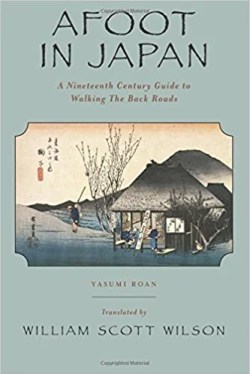
    • Wilson, W.S. (2016) “Afoot in Japan: A nineteenth century guide to walking the back roads.” Shambhala Publications.

    Feature Image: Hinomisaki, Izumo by Kawase Hasui.

    You can listen to the full podcast episodes here: Japan Archives, or wherever you listen to Podcasts.

    Follow us on Social Media: Instagram: @japan_archives

    We also started a Youtube channel for Japan Archives.

    And another for other creative endeavours!

    Heavenly Spear
  • EP8B Order 9066 and 1000 Cranes

    EP8B Order 9066 and 1000 Cranes

    Show Notes for EP8B – Order 9066 and 1000 Cranes. (Show notes today by Heather).

    Story Notes:

    Order 9066 and 1000 Cranes

    Sometimes there is a call to action. That even if you know what you are doing may not have a huge effect, but sometimes you need to do anything you can.

    For this week’s episode, we are going to be telling two stories from the era of World War 2. One in America, and one in Japan.

    Our first story is not from Japan. And our subject isn’t Japanese. However, what he did for Japanese people in America needs to be told.

    Ralph Lazo was born November 3 1924, in Los Angeles. His mother died when he was quite young, so he grew up with his father and his sister Virginia. Ralph was very popular, and made many friends. His neighborhood was filled with many different families of various descents: Jewish, Mexican, Chinese, Caucasian, Korean, Filipino, and Japanese.

    Ralph was a teenager at Belmont high school when, on February 19, 1942,  President FD Roosevelt signed Order 9066. This order commanded anyone of Japanese decent, up to 1/16 Japanese in fact , to be relocated and incarcerated in internment camps along the Western, Midwest, and parts of the southern United States. There were around 127,000 Japanese Americans in the continental US and about 112,000 lived on the west Coast. Of those, around 80,000 were second generation, or “Nisei,” children born in the US and third generation, “Sansei” Now, Hawaii also had a large Japanese population, but only about 1200 – 1800 of the over 150,000 actually went to the camps.

    Japanese Americans closed homes, shops, restaurants, and went to join the camps. Tensions and blame were high during this time, as the huge majority of people looked on the Japanese Americans who had previously been their friends and neighbors with suspicion and distrust.

    Now, Ralph had made a lot of Japanese friends, and had even taken some Japanese classes himself so he could speak a little Japanese. However, Ralph was of Mexican-Irish decent.

    That didn’t stop Ralph from going along with his friends. In May of 1942, Ralph told his dad he was off to camp – he didn’t say What Camp – and took the train to Manzanar. No one bothered to ask his nationality. He was able to join no problem.

    So, Ralph went to school, joked, and laughed and told stories and tried to keep up everyone’s spirits in the camp. Conditions were military style, and many of the camps were extremely hot in winter and cold in summer.

    Ralph stayed with his friends in the camps until he was drafted into the Army in August 1944. He didn’t get into any trouble, and his story was even reported in the Las Angeles times.

    Not only did Ralph support and love his friends when most people were turning their back on the Japanese community, he also fought with his friends to request the government to give reparations to the thousands of Japanese Americans who spent years in the internment camps. And in 1988, the US Government issued a formal apology for this incarceration. The camps were active from 1942-1946.

    Our second story happens after World War 2.

    Order 9066 and 1000 Cranes
    Cranes of Hiroshima Peace Park

    Sadako Sasaki was 2 years old when the bomb fell on Hiroshima. She lived around 1.6 kilometers, or a mile away from ground zero, but had received no injuries after the blast.

    She grew up a regular girl and was a very accomplished runner in school.

    It wasn’t until 10 years after the bomb that she began to get sick. It began with swelling behind her neck and ears. Doctors discovered that she had acute malignant lymph gland leukemia. She was admitted to the hospital in February 1955.

    It was during her hospitalization that she received paper cranes from a local high school club. Sadako’s father shared with her the story of the cranes – if you make 1000 paper cranes, you can get a wish granted. So, Sadako set out to make those 1,000 cranes in hopes to make her wish of recovery come true.One version of Sadako’s story says that she fell short of her 1000 crane goal, but Masahiro Sasaki says that she not only reached but went well over the 1000 cranes needed to make her wish come true.

    Unfortunately, Sadako was unable to recover and died October 25, 1955. She  was 12 years old.

    Now, Sadako was a very kind child and much loved by her friends. They decided to make a memorial for her and all the children affected by the atomic bomb and for the hopes that this tragedy would never occur again. They published a letter collection to raise money to build this memorial. And in 1958,  Sadako’s statue was built  in the Hiroshima Peace Memorial Park. She’s holding a crane and the plaque on the statue reads “This is our cry. This is our prayer. Peace in the World.”

    If you visit the Peace Memorial Park, you can make your own paper crane for Sadako and the children affected by the atomic bomb.  I also saw on Hiroshima’s website that you can make and mail in your own paper crane, but I am not sure if they are still receiving the cranes or not. My husband and I are planning to go to the memorial park soon and will find out more there.

    In the meanwhile, you can celebrate August 6th as a day of peace. Please make your own paper cranes, but before you fold, write a wish for peace.

    Poem Notes

    Order 9066 and 1000 Cranes
    Daini no Sanmi

    Daini no Sanmi was born in 999AD, the daughter of Muraski Shibuki her poetry was included in numerous works such as the Goshūishū and the Ogura Hyakunin Isshu. In addition to being a poet she was also known to have been the wet nurse to the Emperor Go-Reizei.

    Her poem today comes from the Ogura Hyakunin Isshu and goes as follows:

    有馬山
    猪名の笹原
    風吹けば
    いでそよ人を
    忘れやはする

    Arimayama
    Ina no sasahara
    kaze fukeba
    ide soyo hito o
    wasure ya wa suru

    Blown down from Mount Arima
    through Ina’s low bamboo
    the wind whispers,
    ‘I swear of my love-
    how could I forget you?’

    References

    You can listen to the full podcast episodes here: Japan Archives, or wherever you listen to Podcasts.

    Follow us on Social Media: Instagram: @japan_archives

    We also started a Youtube channel for Japan Archives.

    And another for other creative endeavours!

    Heavenly Spear
  • EP8A Righteous Among Nations

    EP8A Righteous Among Nations

    Show Notes for EP8A – Righteous Among Nations


    Story Notes:

    Righteous Amongst Nations

    Chiune Sugihara was born 1 January, 1900  in Gifu prefecture. The second son of Yoshima and Yatsu, he had 5 brothers and one sister.  His family lived in a borrowed temple, close to Kyosen-ji. 

    He moved to many elementary schools but in December 1907 transferred to Nagoya Municipal Furuwatari Elementary where he graduated with honors. After he moved to Aichi prefectural secondary school, a combined school for both Junior High and High School Students. 


    As he grew up his father wanted him to become a physician, but Chiune did not share his father’s future idea. He failed the entrance exam for the course by only writing his name.

    In 1918 (Taisho Era 7) he entered into Waseda University where he studied to major in the English language. To help improve his English he also entered into a Christian fraternity founded by a Baptist pastor. And in 1919 he finished the Foreign Ministry Scholarship exam.

    Chiune served for a time in the Japanese Imperial Army as a second lieutenant from 1920 to 1922. During this time he was stationed in Korea, which at the time was still a Japanese colony. However, by November 1922 he resigned from the post and moved on to return to education, passing the Foreign Ministry Language Exam the next year, which he passes with distinction. 

    Because of this distinction, he was recruited by the Japan Foreign Ministry and eventually assigned to China in the city of Harbin. While he was there, he also studied Russian and German. We could say he was a man very skilled at learning languages. 

    Now some time passes, and he is now serving the Manchurian Foreign Office (What is Manchuria? It was a term coined by the Japanese to cover a large area of northeast Asia, which could encompass large sections of China and Russia.)

    During his time here he took part in negotiations with the Soviet Union about the Northern Manchurian Railroad. And it was during this time he married for the first time. Converting to Christianity, he married a woman called Klaudia Apollonova. His baptized name during for this marriage was Sergei Pavelovich.

    However, by 1935 he quit his post as he disagreed with the mistreatment of the local Chinese living in this area. This mistreatment being caused by the Japanese who oversaw them.

    And so he divorced Klaudia and returned to Japan.

    Here he married his second wife Yukiko Kikushi and together they had four sons.

    World War Two begins on September 1 1939. This same year Chiune moves to Lithuania, and the city of Kaunas. His role whilst here was to keep tabs on the Soviet and German troop movements and to relay any plans the Germans may have had to attack to Soviets. He was to relay these findings to his superiors in both Berlin and Tokyo.

    1940 rolls around and the Soviet Union occupies the country of Lithuania. As we know, the Second World War was a very dangerous time for many groups, including Jews, minorities, homosexuals, and many others. What made it even more dangerous, was the in Luthuania, Jewish people made up a third of the urban population. There were thousand upon thousands of people in urban Lithuania who were now no longer safe. 

    And they all wanted to leave and were desperate for exit visas. Unfortunately it was virtually impossible to find someone or some country willing to issue them so they could escape. In the end, hundreds and hundred of them came to Kaunas where Chiune was, trying desperately to seek visas that would take them to Japan.

    And Chiune wants to help, you know, he can’t see these people die. Or suffer. He can’t leave them stranded. And so he contacts the Foreign Ministry in Japan asking how he can help these people. How he can give them visas.

    And every time Japan says no. That these people who aren’t safe, these people who could die, did not fit the criteria to be worthy of a visa. They needed money the Ministry told him, that they had already undergone appropriate immigration procedures, and that they also held another visa which let them go to another destination, as they couldn’t remain in Japan. And the Ministry said that they would not make an exception.

    And Chiune did the only thing he could do. He disobeyed, he went against his orders, which for Japanese people is almost unheard of. And at times is very difficult to do. 

    And so on July 18th 1940 he started writing his visas, ten day visas which would give all these people a safe passage to Japan via the Trans-Siberian Railway. Though it did have a cost, and the Soviets demanded that these people pay 5 times the normal ticket price if they truly wanted to escape and leave.

    He hand wrote these visas, from 18 to 20 hours a day. Each day he wrote a months’ worth of visas, and he didn’t stop until the 4th of September. He had written thousand of visas to allow people to reach safety, at times ensuring he gave them to the head of a household as it allowed and permitted them to take their families with them.

    Chiune was reassigned to Konisberg in East Prussia.

    Some reports state he left his consulate seal, so other people could make more visas after he left, though his son in a interview has stated this to be false. Others report, he continued to write visas while still leaving and making his way to his hotel, handing them out as he left. And then boarding the train at Kaunas Station he continued to write on the train as many as he could. Throwing them out the window to those who were still desperate to leave. And as the train left, in desperation he merely made sheets with his seal and signature to throw from the train which hopefully could have the rest of the ‘visas’ written upon it later. 

    The last thing he did as he left was apologize he couldn’t do more. Saying, “Please forgive me. I cannot write anymore. I wish you the best.”

    It is said, someone could be heard saying. “We’ll never forget you. I’ll surely see you again.”

    Chiune had done everything he could have for these people.

    During the Second World War between 91 and 95% of the Jewish population of Lithuania were Jews. Which was pretty much, every single Jew who didn’t manage to leave the country. It is the highest casualty rate of any nation for the Holocaust. 

    It turned out* that Chiune was responsible for saving the Mir Yeshiva. A Yeshiva is a Jewish Educational Institute with a focus on studying traditional religious texts such as the Talmud and Torah. This was the only European Yeshiva that survived the Holocaust. Because of Chiune this Yeshiva survived and made it way to Kobe where is stayed for a while.

    In total it is debated how many Jews Chiune saved, some say 6,000, others say, 10,000.. It is difficult when you consider, one visa could save and ensure the safe travel for an entire family.

    However, recently I discovered that there is a museum around the corner form Tokyo Station about Chiune where it lists what they say is ‘all 2,139 name of the refugees who received life saving visas.’

    Chiune and his family were now stationed in East Prussia, But by 1944, Soviet Troops invaded. He and his family were interred in a POW camp where they stayed for 18 months. Eventually released in 1946 they returned to Japan and the following year he was asked to resign. 

    Now some sources would say it was because the Japan Foreign Office was downsizing, but there are also other sources, and even his wife says this, that he was asked to resign due to, I’m using quote marks here, “that incident in Lithuania.” Which if true, is quite horrible. They new what he did to save all these lives, and instead of thanking and celebrating him. It seems like they made him resign, as it went against their orders. 

    It wasn’t until 1969 that people began lobbying for his recognition for what he did to save all those lives and the following year in 1970 he was given this recognition and called Righteous Amongst the Nations. Sadly he was too ill at the time to travel, and so his wife and son Nobuki went on his behalf.

    In 1985, he was asked for the reasons he did what he did. And this was his response.

    You want to know about my motivation, don’t you? Well. It is the kind of sentiments anyone would have when he actually sees refugees face to face, begging with tears in their eyes. He just cannot help but sympathize with them. Among the refugees were the elderly and women. They were so desperate that they went so far as to kiss my shoes, Yes, I actually witnessed such scenes with my own eyes. Also, I felt at that time, that the Japanese government did not have any uniform opinion in Tokyo. Some Japanese military leaders were just scared because of the pressure from the Nazis; while other officials in the Home Ministry were simply ambivalent.

    People in Tokyo were not united. I felt it silly to deal with them. So, I made up my mind not to wait for their reply. I knew that somebody would surely complain about me in the future. But, I myself thought this would be the right thing to do. There is nothing wrong in saving many people’s lives…The spirit of humanity, philanthropy…neighborly friendship…with this spirit, I ventured to do what I did, confronting this most difficult situation—and because of this reason, I went ahead with redoubled courage. 

    Sugihara died the following year on 31 July 1986. And in spite of the publicity given him in Israel and other nations, he remained virtually unknown in his home country for a long time. It was only when a large Jewish delegation from around the world, including the Israeli ambassador to Japan, attended his funeral, did his neighbors find out what he had done.


    Poem Notes:

    Yamanoue no Okura (山上憶良) was a waka poet and lived during the Nara period. He is said to have died at the age of 74 in 733AD.

    It is known that in 701AD he was sent to China, as part of an embassy which was led by a man known as Awata Mahito. His poem today comes from the manyōshū and goes as follows:

    世閒を
    憂しとやさしと
    思へども
    飛び立ちかねつ
    鳥にしあらねば

    yo no naka wo
    ushi to yasashi tö
    omoedömo
    tobitachikanetsu
    tori ni shi araneba

    Even if this world is full of pain or easy,
    it doesn’t matter
    I can’t help staying here
    I am not a bird at all.

    Feature Image: Chiune and his wife Yukiko.


    You can listen to the full podcast episodes here: Japan Archives, or wherever you listen to Podcasts.

    Follow us on Social Media: Instagram: @japan_archives

    We also started a Youtube channel for Japan Archives.

    And another for other creative endeavours!

    Heavenly Spear
  • EP7 Target: Nobunaga

    EP7 Target: Nobunaga

    Show Notes for EP7 of our Podcast – Target: Nobunaga.

    Story Notes

    Target Nobunaga

    Sugitani Zenjubo (杉谷善住坊) was born to one of the 53 families of the Koga Clan, acting as Ninja and Sniper for them until his death in 1573. He was best known for his use of the matchlock rifle (hinawa-ju).

    Initially the Koga Clan was approached by the local lord Rokkaku Yoshitaka who came with the idea to assassinate Oda Nobunaga. The clan chose Sugitani for the job.

    Sugitani luckily finds out that Nobunaga will be in Omi Province in the near future, taking the Chigusa Road, in an attempt to avoid the exposed Tokaido Road. And so he goes there and hides in advance, scouting an exit route as his rifle would leave a smoke trail for others to spot him.

    Eventually the day in question arrives, the 19th May, 1570. Nobunaga arrives with retinue at the Chigusa Road.

    The sniper takes the shot, but his bullet hits Nobunaga’s collar-armor meaning Sugitani is forced to flee and goes into hiding. He finds safety for a while in the temple of Amida-ji, in Omi Province. However, the area is owned by Isono Kazumasa. Isono hears Sugitani is here and wanting to to curry favor with Nobunaga he apprehends him, handing him to Nobunaga.

    Nobunaga personally oversees his his execution where he is buried up to neck, with his head slowly removed (some say over a few day, some say hours) with dull-edged blades of bamboo.

    Poem Notes

    Target: Nobunaga
    Kobayashi Issa by Muramatsu Shunpo.

    Kobayashi Issa ( 小林 一茶 ) lived from 1763 and 1828. During his life he was both a Poet and Priest. Issa, his pen name, used the Kanji for ‘cup of tea.’ He was also known for his autobiographical journals, which were full of both poetry and drawings.

    すず風や 
    力いっぱい 
    きりぎりす

    Suzukaze ya
    Chikara ippai
    Kirigirisu

    The cool breeze.
    With all his strength
    The cricket.

    References

    • Carter, S.D. (1991) “Traditional Japanese Poetry: An Anthology.” Stanford: Standford University Press.
    • Masterpiece of Japanese Culture: Website link here.
    • Yoda, H & Alt, M. (2012) “Ninja Attack: True Tales of Assassins, Samurai and Outlaws” Tokyo: Tuttle Publishing. 

    Feature Image: Ninja, by Hokusai.

    You can listen to the full podcast episodes here: Japan Archives, or wherever you listen to Podcasts.

    Follow us on Social Media: Instagram: @japan_archives

    We also started a Youtube channel for Japan Archives.

    And another for other creative endeavours!

    Heavenly Spear
  • EP6 Lord of Rice

    EP6 Lord of Rice

    Show Notes for EP6 of our Podcast – Lord of Rice.

    Story Notes

    Lord of Rice

    Fujiwara Hidesato, also known as Tawara Toda, wished for adventure and so one day set out.

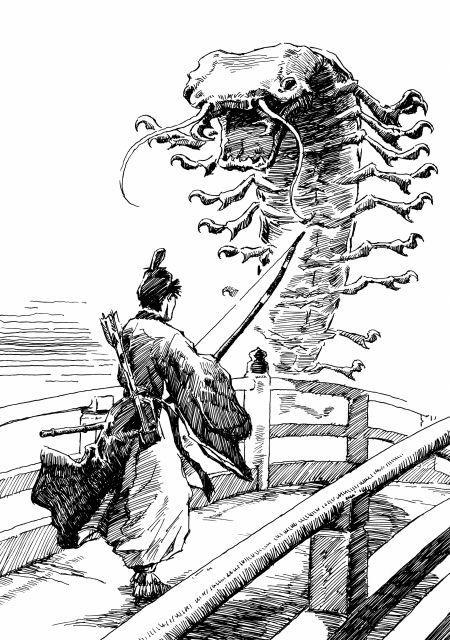
    Reaching Seta-no-Karashi Bridge on Lake Biwa he finds a serpent-dragon sleeping across it. Undeterred he walks over the Dragon, afterwards, the Dragon changes into a man, revealing himself to be The Dragon King.

    The Dragon King beseeches Tawara for his help, telling him that The Giant Centipede Seta is plaguing his people from Mount Mikami after the creature discovered the King’s home.

    The centipede, The King says, comes every night and takes away members of his family. He needs a hero to kill The Centipede. Tawara agrees, the Dragon King taking him to his Palace to await the hour the centipede descends from the mountain. When the centipede finally appears Fujiwara asks for his bow and arrow.

    Having only three arrows the first two hit the centre of its head but only bounce off, causing no harm. Finally, Fujiwara remembers that human saliva was deadly to centipedes. And so placing the tip of his final arrow in his mouth, wetting it, he fires once more.

    The arrow hits the mark, killing the centipede, its dead body floating in the lake. Afterwards, in thanks, the King throws a feast and asks Fujiwara to stay in his Palace but he declines.

    So in thanks, Fujiwara is gifted with several items:

    • A large bronze bell.
    • A bag of rice.
    • A roll of silk.
    • A cooking pot.
    • A bell.

    In the end, the bell he donates to Mii-dera Temple. The bag of rice never grew empty. The roll of silk never grew shorter. The cooking pot, no matter what was put in cooked delicious food, and so Fujiwara grew very wealthy as a result.

    Poem Notes

    Lord of Rice
    Matsuo Bashō

    Today’s Poem was inspired from the Ghibli film, My Neighbor the Yamada’s as this film cites several of Matsuo Bashō’s poetry. This film was aired in 1999 as sadly was not as popular as other Ghibli films. The movie was animated differently, and was the first time they created animation in a water color style by ‘drawing’ them directly onto a computer.

    Matsuo Bashō was born in 1644 during the Edo Period and is known as the ‘Greatest Master of Haiku,’ a poetic form in 3 lines of 5-7-5 syllables.

    夏かけて
    名月暑き
    涼み哉

    Natsu kakete
    meigetsu atsuki
    suzumi kana

    Translation 1:
    Past Summer
    The full moon is still so hot
    I feel summer clothes

    Translation 2:
    Still summer
    The harvest moon too hot
    To enjoy the coolness

    Feature Image: Fujiwara and the Centipede from Illustramble.

    You can listen to the full podcast episodes here: Japan Archives, or wherever you listen to Podcasts.

    Follow us on Social Media: Instagram: @japan_archives

    We also started a Youtube channel for Japan Archives.

    And another for other creative endeavours!

    Heavenly Spear
  • EP5 Weaver of Heaven

    EP5 Weaver of Heaven

    Show Notes for EP5 of our Podcast – Tanabata – Weaver of Heaven.

    Story and Song Notes

    Tanabata

    The festival of Tanabata can trace it origins to the Empress Koken when it was adopted by Japan from the Heian Period. The festival has lasted to this day.

    The story of the festival relates to the Goddess known as Orihime (the Weaving Princess). She was the daughter of the God Tentei, and Orihime spent her days weaving beautiful clothes along the shores of the Amanogawa (Milky Way)

    Orihime knew how much her father loved the items she wove, and so she worked tirelessly everyday to make more for him. But, due to this she would never fall in love.

    Her father eventually grew concerned for her, wanting her to find love and a husband and so he arranged for her to meet with the God known as Hikoboshi (Cowman/Boy Star) who at the time lived on the other side of the Amanogawa.

    Her father was happy to see that when the two of them met they both instantly fell in love with one another.

    However, his happiness grew sour soon after. Now that they had married, Orihime no longer had time to weave her beautiful things for her father and so in his anger he separated the two of them at opposite sides of the Amanogawa and forbid them from ever seeing one another again.

    His daughter was heart broken, and grew mournful, her tears raining down.

    She asked her father if she could please see him again, and he relented, allowing them to meet on the 7th day of the 7th month as long as she worked hard with her weaving.

    She worked hard until the time came for them to meet, only to find that there was no bridge across the Amanogawa for them to meet. Orihime cried and cried, until a flock of magpies took note and offered their aid. They promised they would make a bridge for her every year with their wings so that she may walk across them to see her husband.

    It is said on the years when it should rain on this day, the magpies are unable to form a bridge because the river would rise and it would be too dangerous for them to form a bridge for the two lovers.

    The traditional song of the Tanabata festival goes as follows:

    笹の葉 さらさら
    退き葉に 揺れる
    お星様 きらきら
    金銀 砂ご
    五色の 短冊
    私が 書いた
    お星様 きらきら
    空から  見てる

    Sasa no ha sara-sara
    Nokiba ni yureru
    Ohoshi-sama kira-kira
    Kingin sunago
    Goshiki no tanzaku
    Watashi ga kaita
    Ohoshi-sama kirakira
    Sora kara miteru

    The bamboo leaves rustle,
    shaking away in the leaves.
    The stars twinkle
    on the gold and silver grains of sand.
    The five-color paper strips
    I have already written.
    The stars twinkle,
    and there they will watch us.

    Feature Image: Orihime and Hikoboshi from animeclick.it

    You can listen to the full podcast episodes here: Japan Archives, or wherever you listen to Podcasts.

    Follow us on Social Media: Instagram: @japan_archives

    We also started a Youtube channel for Japan Archives.

    And another for other creative endeavours!

    Heavenly Spear
  • EP4 Samurai Weatherman

    EP4 Samurai Weatherman

    Show Notes for EP4 – Samurai Weatherman. We have some extra notes here for you about Sekiso from our database about him.

    Story Notes:

    Samurai Weatherman

    Tsunokuma Sekiso (角隈 石宗) was a Gunbaisha (Military Strategist) and Vassal during the Azuchi-Momoyama Period for the Warlord Otomo Sorin. He died during the Battle of Mimikawa in 1578.

    Records from his life state that he was a man who held supernatural abilities. For example, he could conjure up a whirlwind full of wakizashi (short swords) which would cut apart his foes. In addition, he could also call down passing ravens, as well as snap a branch from a tree with a sparrow upon it without disturbing the sparrow.

    During his time he was called a ‘master of moral teachings and martial arts,’ and even Catholic missionaries had respect for him. The Portugese Missionary Luis Frois wrote about him in his book ‘History of Japan’ in 1593 where he actively praised his weather predicting abilities. Though they did fail to convert him to Christianity. He would even teach other how they could predict and forecast the weather. Due to this ability there are meteorologists to this day who class him as an honored ancestor.

    He eventually was killed during the Battle of Mimikawa, following Lord Otomo into battle; though Sekiso had advised against it. He predicted the battle would go badly for them using his supernatural abilities. However, by this point Lord Otomo had converted to Christian and would no longer listen to his ‘pagan’ beliefs. And so Sekiso, remaining loyal to his master, followed him into battle, where he died.

    Children’s Song Notes:

    Here is the Romanization and the translation of the children’s song Heather found this week in one of her study books.

    ほ ほ ほたる こい
    あっちの みずは にがいぞ
    こっちの みずは あまいぞ
    ほ ほ ほたる こい

    Ho Ho hotaru koi
    Achi no midzu wa nigai zo
    Kochi no midzu wa amai zo
    Ho Ho Hotaru koi

    Fly, Fly, firefly come
    The water over there tastes bitter
    The water over here taste sweeter
    Fly, fly, firefly come.

    References

    • Bock, F.G. (1949) “Japanese Childrens Songs,” Western Folklore Vol.8, No.4 pp.328-341.
    • Yoda, H & Alt, M. (2012) “Ninja Attack: True Tales of Assassins, Samurai and Outlaws” Tokyo: Tuttle Publishing. 

    Feature Image: Samurai in armor in 1860s; hand-colored photograph by Felice Beato.

    You can listen to the full podcast episodes here: Japan Archives, or wherever you listen to Podcasts.

    Follow us on Social Media: Instagram: @japan_archives

    We also started a Youtube channel for Japan Archives.

    And another for other creative endeavours!

    Heavenly Spear
  • EP3 Death of a Goddess

    EP3 Death of a Goddess

    Show Notes for EP3 – Death of a Goddess.

    Story Notes:

    Death of a Goddess
    Izanami and Izanagi with the Jewelled Spear of Heaven.

    Izanami and Izanagi having made the island of Japan, turn to making Spirits.

    Eventually Izanami gives birth to the Fire God – Kagutsuchi. Who, burning her as she gives birth to him, causes her to die.

    Izanagi, angry the child killed his wife kills the Fire God with his Sword and venture into Yomi (the Underworld) to bring back his wife.

    There, he finds she is decomposing, and disgusted by the sight of her flees. Izanami in her anger sends creatures to pursue him, however, Izanagi manages to flee.

    Reaching the Tachibana river where he cleanses himself of the filth of Yomi.

    Poem Notes:

    Death of a Goddess
    Fujiwara Yoshitaka

    Fujiwara no Yoshitaka lived between 954-974AD. He had a son at the age of 18 by the name of Yukinari, but Yoshitaka sadly died at the age of 20. The very same day as his twin brother.

    Many of his poems can be found in waka anthologies. With his poem read today coming from the Ogura Hyakunin Isshu, and goes as follows:

    君がため
    惜しからざりし
    命さへ
    長くもがなと
    思ひけるかな

    Kimi ga tame
    oshikarazarishi
    inochi sae
    nagaku mogana to
    omoinuru kana

    I always thought
    I would give my life
    to meet you only once,
    but now, having spent a night
    with you, I wish that I may
    go on living forever.

    References

    • Kodansha. (1993) ”Japan: An Illustrated Encyclopedia”. Tokyo: Kodansha Ltd. 
    • Louis Frederic, translated by Kathe Roth (2002) “Japan Encyclopedia”. London: Harvard University Press.  
    • MacMillan, P. (2018) ”One Hundred Poets, One Poem Each: A Treasury of Classical Japanese Verse”. St. Ives: Penguin Classics.
    • Aston. W.G. (1896) “Nihongi Volume 1: Chronicles of Japan from the Earliest Times to AD697”. Tuttle Publishing. 
    • Suzuki, H. et al. (1997) ”Genshoku: Ogura Hyakunin Isshu”. Tokyo: Bun’eidō. 
    • Yasumaro. O, translated by Gustav Heldt. (2014) “Kojiki. An Account of Ancient Matters”. New York: Columbia University Press. 

    Featured Image: Izanami in Yomi from taringa.net

    You can listen to the full podcast episodes here: Japan Archives, or wherever you listen to Podcasts.

    Follow us on Social Media: Instagram: @japan_archives

    We also started a Youtube channel for Japan Archives.

    And another for other creative endeavours!

    Heavenly Spear
  • EP2 Iron Rat

    EP2 Iron Rat

    Show Notes for EP2 – Iron Rat.

    Story Notes:

    Iron Rat
    Tesso in the Gazu Hyakki Yagyo.

    Raigo was a Buddhist monk living at the Temple of Mii-dera in Kyoto. He was approached by the Emperor Shirakawa with a proposition. If he was to pray for the safe birth of his son, he would expand his temple.

    Raigo agreed and eventually his son was safely born. However, the Emperor reneged on his pledge and so Raigo went on hunger strike until it killed him.

    His angry spirit returned as a plague of rats called Tesso which attacked the libraries of Kyoto. In particular the temple libraries of Enryaku-ji. A rival temple who helped convince the Emperor to renege on his promise.

    Poem Notes:

    Ono no Komachi was born around the mid 9th century and was possibly a lady-in-waiting under Emperor Ninmyō and Emperor Montoku. It is well attested she was a woman of great beauty who treated her lovers cruelly, however, it is likely this is merely a legend. In fact there are many legends now revolving around her it is difficult to separate the truth from the myth.

    Iron Rat
    Ono no Komachi.

    Her fame in poetry saw that she was included in Kinto’s list of the Thirty-Six Poetic Geniuses, as well as Thirty-Six Women Poetic Geniuses. Prior to this she is included as part of the Six Poetic Geniuses, and she is the only woman in this list of six.

    Her poetry is collected in numerous works including the Kokinshū and Gosenshū, however, only 21 poems attributed to her are seen as authentic. There are many poems attributed to her in later sources that may likely not be hers. The Komachi-shū (Collected Poems of Komachi), created after her death also contains poetry that is unlikely to be hers.

    Famously one of her poems can be found in the Ogura Hyakunin Isshu (One Hundred Poems, One Poet Each). Her poem is the 9th in the anthology and reads:

    花の色は
    うつりにけりな
    いたづらに
    わが身世にふる        
    ながめせしまに

    Hana no iro wa
    utsurinikeri na
    itazura ni
    wa ga mi yo ni furu        
    nagame seshi ma ni

    A life in vain.
    My looks, talents faded
    like these cherry blossoms
    paling in the endless rains
    that I gaze out upon, alone.

    References

    • Louis Frederic, translated by Kathe Roth (2002) “Japan Encyclopedia”. London: Harvard University Press.  
    • Kodansha. (1993) ”Japan: An Illustrated Encyclopedia”. Tokyo: Kodansha Ltd. 
    • MacMillan, P. (2018) ”One Hundred Poets, One Poem Each: A Treasury of Classical Japanese Verse”. St. Ives: Penguin Classics. 
    • Suzuki, H. et al. (1997) ”Genshoku: Ogura Hyakunin Isshu”. Tokyo: Bun’eidō. 
    • Yoda, H. and Alt, M. (2016) “Japandemonium: Illustrated: The Yokai Encyclopaedia of Toriyama Sekien.”. New York: over Publications, Inc.

    Feature Image: Tesso by gegebo on deviantart.

    You can listen to the full podcast episodes here: Japan Archives, or wherever you listen to Podcasts.

    Follow us on Social Media: Instagram: @japan_archives

    We also started a Youtube channel for Japan Archives.

    And another for other creative endeavours!

    Heavenly Spear
  • EP1 Heavenly Spear

    EP1 Heavenly Spear

    Show Notes for EP1 – Heavenly Spear.


    Story Notes:

    Heavenly Spear
    Izanami and Izanagi on the Floating Bridge of Heaven. (Museum of Fine Arts, Boston.)

    Izanami and Izanagi, tasked with the creation of the lands below are given the gift of the Jewelled Spear of Heaven. They thrust down this Heavenly Spear into the sea below from their vantage point on the Floating Bridge of Heaven they see the brine which falls from it form into the first island. The island of Onogoroshima. And from there the create the First Eight Islands of Japan.

    The first eight islands made related in the Kojiki are Awaji Shima, Iyo, Okigashima, Tsukushi, Ikinoshima, Tsushima, Sado Island and Yamato.

    The Nihongi gives a different list of islands birthed by these kami. Izanami being the mother of (in order of birth), Ohoyamatonotoyoakitsushima, Iyo, Tsukushi, Oki and Sado Island, Koshi, Ohoshima, Kibi no Ko, Tsushima and Iki.

    Heavenly Spear
    Book cover of Afoot in Japan.

    Poem Notes:

    Today’s poem is by Yasumi Roan. He was an experienced traveler for his time, writing and publishing the book known as the Ryoko Yojinshu which would later be reprinted as Afoot in Japan. His work includes detailed tips for the places he visits, as well as numerous poems on a myriad of different subjects. Within his works, he even included printed talismans to protect those who may encounter danger whilst out on the road.

    His poem goes as follows:

    首中は
    自由 をせんと
    思ふまし
    ふ自由 せんとすれば
    自由ふぞ

    Douchu ha
    jiyu o sento
    omoufumashi
    fujiyu sento sureba
    juyu fuzo

    Do not think
    “I’ll go as I please!”
    When taking a journey.
    Rather, I think, “I may have some problems.”
    And you’ll be free as a bird.

    References

    • Aston. W.G. (1896) “Nihongi Volume 1: Chronicles of Japan from the Earliest Times to AD697”. Tuttle Publishing. 
    • Yasumaro. O, translated by Gustav Heldt. (2014) “Kojiki. An Account of Ancient Matters”. New York: Columbia University Press. 
    • Wilson, W.S. (2016) “Afoot in Japan: A nineteenth century guide to walking the back roads.” Shambhala Publications.

    Feature Image: Izanami and Izanagi by lady-voldything on deviantart.

    You can listen to the full podcast episodes here: Japan Archives, or wherever you listen to Podcasts.

    Follow us on Social Media: Instagram: @japan_archives

    We also started a Youtube channel for Japan Archives.

    And another for other creative endeavours!

    Heavenly Spear